Instructions
A local biologist needs a program to predict population growth. The inputs would be:
- The initial number of organisms, as an int
- The rate of growth (a real number greater than 1), as a float
- The number of hours it takes to achieve this rate, as an int
- A number of hours during which the population grows, as an int
For example, one might start with a population of 500 organisms, a growth rate of 2, and a growth period to achieve this rate of 6 hours. Assuming that none of the organisms die, this would imply that this population would double in size every 6 hours. Thus, after allowing 6 hours for growth, we would have 1000 organisms, and after 12 hours, we would have 2000 organisms.
Write a program that takes these inputs and displays a prediction of the total population.
An example of the program input and output is shown below:
Enter the initial number of organisms: 10
Enter the rate of growth [a real number > 1]: 2
Enter the number of hours to achieve the rate of growth: 2
Enter the total hours of growth: 6

The total population is 80
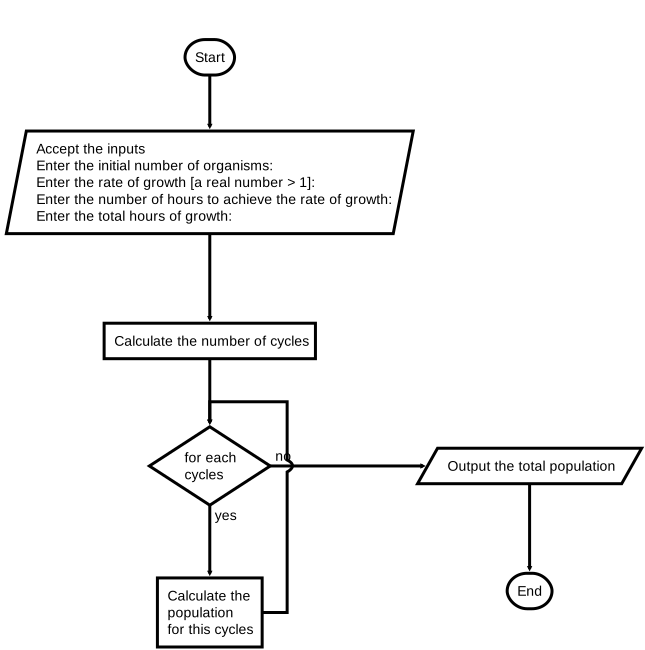
Flowchart
To enlarge flowchart turn side navigation off, Click on  in the top navigation bar to change to
Starter Code
"""
Program: population.py
Project 3.5

Predict population growth, assuming that no
organisms die.

Inputs:
   initial number of organisms
   rate of growth (a float > 1)
   the number of hours to achieve the rate
   number of hours of growth
"""

# Accept the inputs

# Calculate the number of cycles

# Calculate the population after an integral number of cycles

# Output the total population